
Don't roll off the ground and hit the space! Musk uses Vera Rubin Zhongke Dawn to use domestic
Fast Technology reported on November 10 that space computing is becoming a new battleground for the Sino-US hashrate competition. At the same time that Musk announced that he and Nvidia would send Vera Rubin into orbit, Zhongke Duguang gathered 16 industrial and state-owned forces, formally established Zhongke Nebula in Hefei, and launched the launching gun of domestic space computing infrastructure.
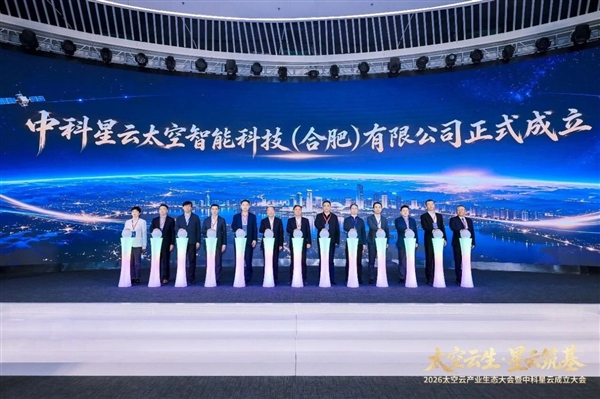
On November 9, Zhongke Xingyun Space Intelligent Technology (Hefei) Co., Ltd. was formally established and put into operation with a registered capital of 1.5 billion yuan. It was jointly established by six industrial entities such as Zhongke Shuguang, Haiguang Information, and Zhongke Star Map, and a total of 16 entities at the two levels of the United Nations Science and Technology Development, Chengtong Science and Technology Innovation, and Anhui Province and Municipality Investment Platform.
On the other side of the ocean, Musk disclosed the space computing roadmap with Nvidia at the Barron's Investment Conference: the first StarMind space computing devices jointly designed by the two parties are planned to be launched into orbit in the third quarter of 2027 and enter the large-scale deployment stage from 2028 to 2029. The core hardware directly adopts Nvidia's top-class Vera Rubin NVL72 computing platform.
Sino-US space computing power routes present very different technological paths. Musk took the route of "high-end computing power on the ground". Relying on SpaceX's starship launch capability and Starlink laser link, he directly moved the strongest AI rack system on the ground into orbit, aiming at large-scale AI reasoning and training.
Zhongke Nebula takes the full-stack domestic vertical integration route: Haiguang Information provides domestic high-end computing power chips, Zhongke Shuguang provides server whole machine and intelligent computing infrastructure, and Satellite Measurement and Control and Zhongke Satellite provide constellation operation and remote sensing data, covering the complete chain from chip to application.
In terms of technical goals, Zhongke Nebula proposed a three-step strategy to move from "days to days" to "heaven and earth equivalence": first achieve sensory computing integration, so that satellites can perform side-by-side calculations; then achieve computational integration, relying on interstellar high-speed interconnection to support constellation coordination; finally converge on-orbit computing power, build a large-scale high-performance orbit data center, and form a computing power network that uses synergy to calculate the unified scheduling of heaven and earth.
Musk pointed out that the ultimate bottleneck of AI computing power is electricity, while orbital solar energy obtains about 30% more than the ground, and heat dissipation is more advantageous in vacuum.
When the United States tried to break through energy and land restrictions with a combination of commercial aerospace and top-level GPUs, China chose to respond to the competition with a domestic computing chip and a world-integrated system.
On the table of space computing power, China and the United States have fallen at the same time. The next contest will fall on whose system is more stable, whose cost is lower, and whose constellation is faster to network.

Source: MyDrivers (Fast Technology). Content is presented with source attribution. Read the original report.
Back to News