
AMD Black Technology Uses SSDs as Memory: Cutting DDR5 Performance in Half Remains
On November 11th, AMD officially released an innovative memory solution called MEXT. This solution deeply integrates NVMe SSDs with physical DRAM through a software-defined approach, aiming to alleviate the severe memory cost and supply crisis in the current server market.
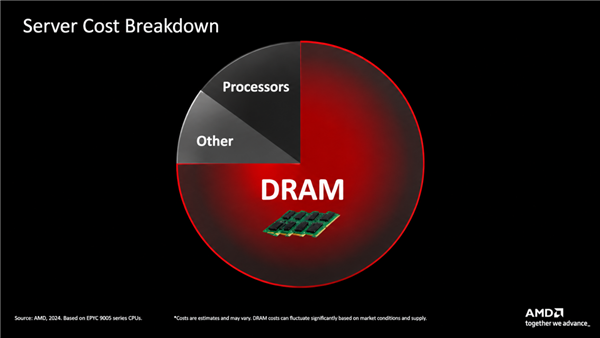
According to industry data provided by AMD, memory costs now account for 75% of total server costs, and memory prices have recently soared from about $8 per GB to more than $10.
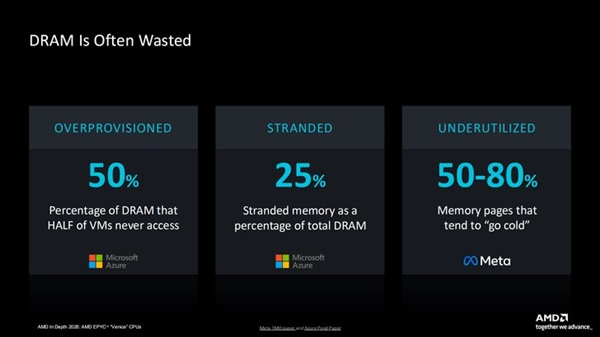
What is more serious is that there is a huge waste of resources in the data center. Microsoft Azure and Meta surveys show that about 50% of the memory is over-allocated, while 50% to 80% of the memory pages are in a cold data state for a long time and have never been effectively used.
The core of MEXT technology is to offset the latency disadvantage of flash memory through AI algorithms. Although flash memory costs half the memory and consumes 30 times less power, it is 500 times slower to access than DRAM.
To this end, AMD has integrated a lightweight AI model engine based on the Transformer architecture into the MEXT software for real-time prediction of data needs.
The engine occupies only one EPYC processor core, without GPU involvement, and can complete real-time training in less than 1 second, pushing the upcoming paging from flash memory to physical memory in advance.
In real tests, MEXT showed amazing efficiency. In the Synopsys PrimeTime test in the EDA field, even if the physical memory footprint is reduced by 50%, the system can still retain 95% of the original performance, and the performance per unit memory cost is increased by 1.9 times.
In the more extreme 75% memory reduction test, the system can still maintain 80% performance level, and the cost-per-unit performance ratio is improved by 3.2 times.
At present, MEXT technology has entered the first phase of deployment, mainly for AMD EPYC server platforms equipped with NVMe hard drive bits. AMD said the program has avoided about $4.9 million (35.46 million yuan) in memory procurement expenses out of the initial deployment of 145 servers.
Source: MyDrivers (Fast Technology). Content is presented with source attribution. Read the original report.
Back to News