
Intel's most powerful inference card is ready: 480GB VRAM and 1.5TB/s bandwidth
According to news from Fast Technology on November 12, Intel is reportedly continuing to push driver patches for the Linux 7.5 kernel to improve support for the GPU D series (codenamed Crescent Island) AI acceleration hardware based on the Xe3P architecture. These driver updates focus on hardware monitoring and reliability, marking another step closer to the official mass production and launch of this series of accelerator cards.

Linux 7.5 is the first stable kernel series of 2027. The latest drm-xe-next pull request brings several key adaptations to the D series: the addition of temperature sensor handling in the Xe hardware monitoring code, support for platform-reported VRAM thermal channels, and temperature monitoring capabilities for PCIe and memory controllers.
For data center scenarios, the driver also includes support for Common Platform Error Record (CPER) logs for RAS errors, and adds processing logic for double-bit ECC errors in memory.
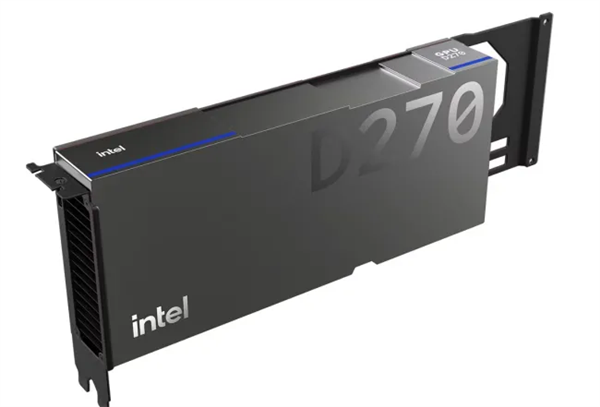
The GPU D Series is Intel's most powerful professional accelerator card for AI inference scenarios, and the flagship model, the D270, has quite aggressive specifications. It integrates 32 Xe3P cores and 256 XMX matrix engines, with an FP8 matrix peak computing power of 1.3 PFLOPS and a memory bandwidth of 1.5 TB/s. The entire card's power consumption is kept at 350W, and it features a PCIe 5.0 x16 interface and an air-cooling design.
The most distinctive feature of the D series is that it completely eliminates display and 3D graphics hardware, being designed specifically for inference workloads. Its VRAM solution is also unique. The standard version comes with 160GB of LPDDR5X, and partners can customize it up to 480GB. The ultra-large video memory enables it to support large language models with up to 300 billion parameters on a single card.
At the software stack level, Unified Shared Memory (USM) is enabled by default on the D Series, and GPU kernels can directly access CPU system memory via C/C++ pointers.
With the ongoing integration of the Linux 7.5 driver patch, the readiness of this inference accelerator card in the open-source ecosystem is rapidly improving, removing key obstacles to its mass production deployment in 2027.
Source: MyDrivers (Fast Technology). Content is presented with source attribution. Read the original report.
Back to News